As an important hub for international trade, the operational efficiency and security of ports are directly related to the smoothness and stability of the global supply chain. The rapid development of IoT technology has brought unprecedented changes to the field of port transportation and logistics, giving rise to the birth of smart ports.
IoT technology realizes the comprehensive interconnection of all kinds of equipment, goods and people in the port by means of wireless sensor networks, RFID tags, GPS positioning systems and other means. These technologies are not only able to collect and transmit data in real time, but also capable of smart analysis and decision-making, providing powerful technical support for port management. In the smart port, IoT technology has become the link connecting various links, promoting the automation and smart upgrade of the port operation process.
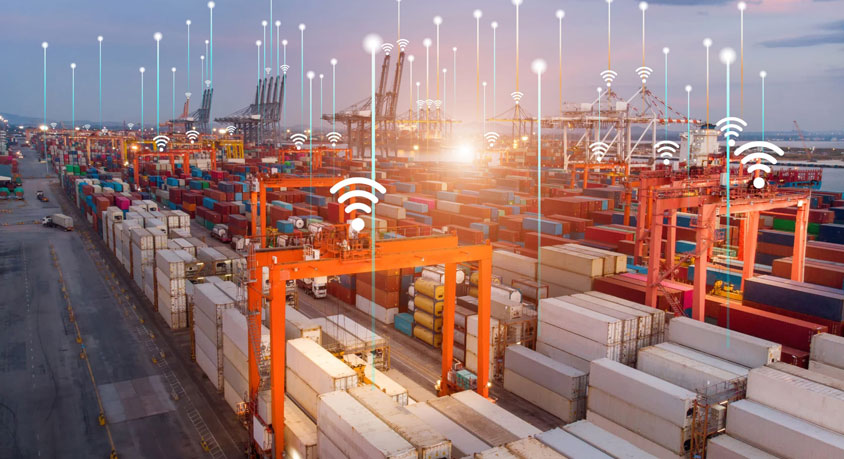
Smart ports use IoT technology to realize the smart tracking of the whole chain of goods and containers from entering to leaving the port. By installing RFID tags or GPS trackers on containers, the system is able to obtain the location, status and transportation information of containers in real time. This information is transmitted to the central control system through the IoT network, and the managers can check the flow of containers anytime and anywhere, adjust the operation plan in time, and reduce the waiting time and resource waste. At the same time, smart tracking technology can also effectively prevent cargo from being lost or misdirected, improving the accuracy and safety of logistics.
The core of smart port lies in the wide application of automated terminal equipment and the deep integration of IoT data. The introduction of automated quay bridges, automated guided vehicles (AGV), automated yards and other equipment has greatly improved the efficiency of port loading and unloading operations. These equipment are interconnected through IoT technology, and are able to receive and execute commands from the central control system to complete the precise gripping, handling and stacking of goods. At the same time, the IoT data integration platform summarizes and analyzes the data generated by various types of equipment to provide decision-making support for port management and achieve optimal allocation of resources and continuous optimization of operation processes.
Smart ports significantly improve the efficiency of international logistics through the application of IoT technology. On the one hand, the application of smart tracking technology and automated terminal equipment shortens the stay time of goods in the port and speeds up the turnover of goods. On the other hand, the IoT data integration platform provides a bridge for information sharing between ports and shipping companies, freight forwarders, customs and other parties, realizing the seamless and rapid transfer of logistics information. This helps all parties to work together, reduces communication costs and time delays, and improves the responsiveness and flexibility of the entire supply chain.
With the continuous development of IoT technology and the continued expansion of application scenarios, smart ports will show a broader development prospect. In the future, smart ports will pay more attention to the development concepts of green, low-carbon and environmental protection, and reduce energy consumption and emissions through the introduction of clean energy and the optimization of operational processes.
Disclaimer: Mention of any brand or trademark is for identification only and does not imply partnership or endorsement