
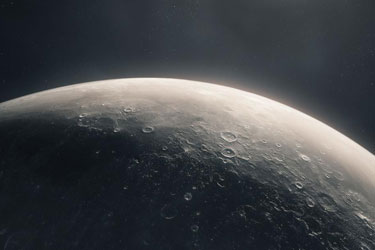
The Existence of the Moon's Thin Atmosphere
Although the Moon does not have enough air for humans to breathe, it does have an extremely thin atmosphere. So how exactly did this thin atmosphere form? Scientists from the Massachusetts Institute of Technology (MIT) and the University of Chicago (UChicago) published a paper in Science Advances that reveals the mystery, pointing out that the moon's atmosphere is mainly derived from impact vaporization.
The process and role of impact vaporization
To understand the process of impact vaporization, we need to start with the Moon's soil. During its long history of 4.5 billion years, the Moon's surface has been subjected to a variety of impacts. At first, there were huge meteorites, then dust-sized "micrometeoroids". These constant impacts lifted up the Moon's soil, vaporizing some of the atoms. Some of the atoms were ejected into space, while others were suspended above the Moon, creating a thin atmosphere. And, as meteorites continued to hit the surface of the Moon, the atmosphere was able to be constantly replenished. As a result, impact vaporization has been the primary way the Moon has produced and maintained its extremely thin atmosphere for billions of years.
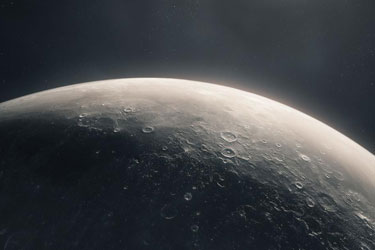
The Quest to Determine the Source of the Moon's Atmosphere
Determining the origin of the Moon's atmosphere has not been an easy task; in 2013, NASA launched the Lunar Atmosphere and Dust Environment Explorer (LADE), which has the important task of clarifying the origin of the Moon's atmosphere.
Nicole Nieh, an assistant professor in the Department of Earth, Atmospheric, and Planetary Sciences at MIT, said, "We hypothesize that two space weathering processes play a role in shaping the lunar atmosphere: impact vaporization and ion sputtering." Ion sputtering is a phenomenon associated with the solar wind. The solar wind carries energetic charged particles from the sun through space, and when these particles hit the lunar surface, they transfer energy to atoms in the soil, causing these atoms to sputter into the air.
Experiments and Analyses to Explore the Origin of the Moon's Atmosphere
To determine more precisely the origin of the Moon's atmosphere, scientists collected 10 samples of lunar soil weighing about 100 milligrams. They first tried to isolate the elements potassium and radium from each sample. These two elements are volatile and each has multiple isotopes, so they can easily evaporate through impacts and ion sputtering.
The scientists reasoned that if the moon's atmosphere is made up of atoms suspended in the air after vaporization, then the lighter isotopes of these elements should float more easily, while the heavier isotopes would be more likely to be redeposited in the soil. Impact vaporization and ion sputtering may cause significant differences in isotope ratios in soils. Specific ratios of light and heavy isotopes of potassium and radium in soils should shed light on the main processes involved in the origin of the lunar atmosphere.
Further analyses suggest that about 70 per cent of the lunar atmosphere is the product of meteorite impacts, while the remaining 30 per cent may have been formed by the solar wind.
Disclaimer: Mention of any brand or trademark is for identification only and does not imply partnership or endorsement